Surviving at high altitude.
We all know the stories of mountaineers climbing the Mount Everest where proper preparation is of vital importance. Not only for survival but certainly also for enjoying a great adventure.
This is also the case when climbing the highest mountain passes of the world in the Himalayas with a motorcycle. With the right preparation a great adventure and without the right information very dangerous. I have driven 8 times through the Himalayas, where 5 times I have been able to climb the highest mountain passes of the world with a group of motorcyclists. If you want to do such an adventure yourself, here are a few useful tips:
 1: Provide backup.
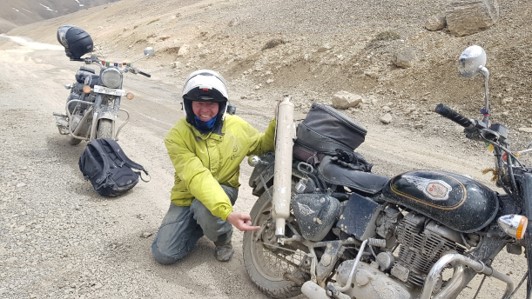
The biggest mistake I almost did made was in 2008, where I literally stood at the turn to Ladakh. (The roof of the world) I had already traveled alone through Turkey, Iran and Pakistan, together with my BMW R1200GS, and the world's highest mountain pass was ready to be climbed. However, the turn was closed for a long time due to snowfall, which led me to continue riding to Nepal. With the knowledge of today I would never have considered that climb on my own at that time. This ascent goes up to a height of 5,600 meters in one track, so the changes on altitude sickness (AMS) due to an oxygen intake of only 50% was actually present. The danger with altitude sickness is that you can get into a intoxication and start to think that it will pass, which means that you will cross your health limits. During my later Himalayan journeys there was therefore always a backup car with locals who were used to the altitude. If necessary, you will be in a lower part within a few hours or, if necessary, at a hospital or medical post.
2: Climb gradually.
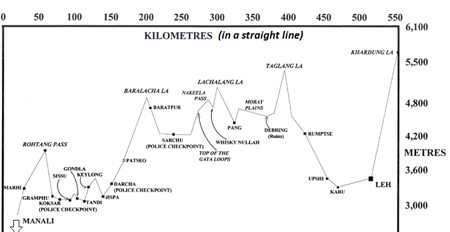
Because your body has to get used to the altitude, in an ideal situation you never sleep more than 500 meters higher than the night before. This is quite a puzzle in this deserted area, as good places to stay are limited. In addition, the simplest road along the Pakistani border runs through Kashmir, where it is still very restless. The best route at this moment is from the east via the Spiti valley, where we are at the foot of the highest mountain pass in the world after 8 driving days. Two nights are in tent camps, but these days tent camps are so luxurious that everyone even has their own toilet at their tent.
3: Medication.
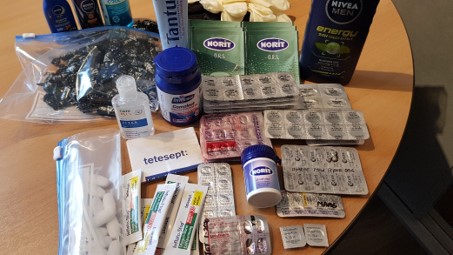
It may sound silly, but paracetamols are indispensable during this (vacation) trip. Everyone gets more or less headache during this trip at the highest point. Because less oxygen is absorbed, the water balance in your body changes, resulting in (slight) headaches. A paracetamole is often enough to keep enjoying the travel. When paracetamol is not sufficient, additional use is often made of Diamox. This is a pill that dissipates moisture so that the headache also disappears. Diamox is normaly available through your doctor. Not really medication but very effective are eucalyptus candies and a good nasal spray, so you simply breathe easily. If all medication does not work, there is ultimately only one solution and that is to descend to a lower location with the backup car.
4: Food and drinks.
To keep the water balance of your body up to date, drinking a lot of water during this trip is highly recommended. For the same reason, drinking alcohol during the climb is not recommended. A beer afterwards therefore tastes extra delicious. Our body uses red blood cells to absorb oxygen, which you could increase by taking extra iron-rich food. However, this does not work for the short period that we are really at a great height. However, it is important not to get a Delhi Belly (diarrhea), so only eat at reliable restaurants and make sure you have ORS (sugar/salt solution) and Imodium (diarrhea inhibitor) with you.
5) Protect your face.

At the highest point during this trip, the UV radiation is 50% to 60% higher than at sea level, which means that sunburn is a big risc. Sun cream is therefore recommended, but it is even better to take a full-face helmet and a good-fitting scarf. Certainly that scarf is actually indispensable because the trip to the highest point in the world is regularly over gravel and sandy roads, with a fair amount of dust. These mountain roads are also used by old lorries that have never seen any kind of filter, so your scarf is often copmpletly black with soot and dust every day.
6) Waterproof clothing.
The route to the highest mountain pass in the world can be traveled for about 3 months a year, because the roads are unreachable due to snow and avalanches for the rest of the year. The great thing is that the 3 months that the roads can be driven there is usually plenty of sunshine and almost no rain. The reason for this is that the monsoon rain in those 3 months is blocked by the first high peaks in the south of the Himalayas. A number of roads are standard always flooded with melt water, which means that waterproof boots and clothing are stil always advisable.
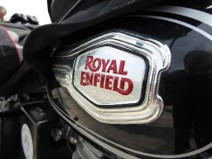 7) Motorbike selection.
Not only does man receive little oxygen at an altitude of 5600 meters, the combustion in a motorcycle engine also regularly craves for a little oxygen. Nowadays modern electronics can arrange a lot, but if you get electronic problems you are stuck in the Himalayas. The solution is simple, always opt for a Royal Enfield motorbike during this adventure. There is always someone on every mountainpass who can blindly (dis) assemble an Enfield and you can find spare parts everywere. If you still want to do the trip with a European or Chinese motorcycle, then choose a not too heavy machine. Certainly when wading so-called road-rivers or some off-road sections, a lighter machine will be much more pleasant.
8) Route.
To get to the highest passable mountain pass in the world you first have to go to India. This can of course be done over land with your own motor as I did in 2008, but a flight to Delhi is easier. If you go on an organized trip, everything will be arranged for you, or else you will have to arrange transportation in Delhi to the foothills on the south side of the Himalayas. Due to unrest at the Pakistani border, the west route via Kashmir is no longer advisable, which means that you automatically have to take the east route. There are 2 possibilities; via Manali using the Rohtang pass or since 2020 via Chandigarh through the Spiti valley. From the foothills it is about an 8-day drive to the capital of Ladakh (the roof of the world) where the Khardung La mountain pass at a height of 5,600 meters is ready to be climbed.
9) planning.
The roads in this area of the Himalayas are only open during the months of June, July and August. Not only the Khardung La must be open, but also the 4-thousands and 5-thousands passes that you have to cross in 8 days, are rarely accessible outside these 3 months. Furthermore, it is very important at this moment to take enough time for the approach route to India, because of the unrest around eastern Turkey, Iran and Pakistan. Various overland travelers arrived last year due to delays just too late at the Himalayan exit, which is then simply closed for 9 months.
10) Get informed.
As mentioned earlier, you can also choose to take a completely organized trip. I am guiding the Himalaya roadtrip every year for a Dutch company. All information about this can be found on my own website where you can also get nice inspiration for other trips:
www.Lifeisjoy.nl. Here you will also find more information about Himalayan home readings and possible discount promotions.